
Last Updated: July 28, 2026 | Medically Reviewed by Grace Oluchi, Medical Graduate
Key Takeaways
- GLP-1 receptor agonists are the fastest-growing class of medication in the US — prescribed for type 2 diabetes, weight loss, and now cardiovascular risk reduction.
- Starting July 1, 2026, Medicare covers Wegovy, Zepbound, and Foundayo for weight loss at $50/month through the GLP-1 Bridge program.
- Foundayo (orforglipron) was FDA-approved on April 1, 2026 — the first oral GLP-1 ever approved for weight management.
- The FDA removed the suicidal ideation warning from Wegovy, Saxenda, and Zepbound in February 2026 after pooling 91 trials and 107,910 patients.
- Major side effects include nausea, vomiting, diarrhea, and possible muscle and bone loss without weight-bearing exercise.
- 3,848 active lawsuits are pending in the federal Wegovy MDL (as of July 2026), primarily involving vision loss and severe GI injury.
- Generic GLP-1s are now available for the first time: Teva liraglutide, Hikma liraglutide, and Amneal exenatide.
What Are GLP-1 Receptor Agonists?
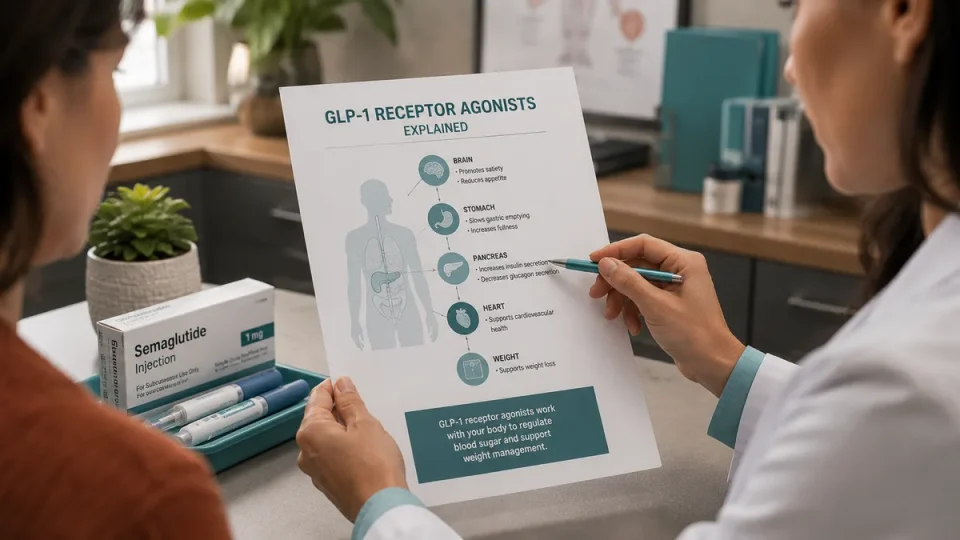
GLP-1 receptor agonists are a class of medication that mimic the effects of a natural gut hormone called glucagon-like peptide-1 (GLP-1). This hormone is released after you eat and helps regulate blood sugar, slow digestion, and signal fullness to the brain.
GLP-1 receptor agonists bind to the same receptors that natural GLP-1 activates. But they are designed to last longer in the body — hours instead of minutes — which makes them far more potent than the body’s own hormone.
Originally developed for type 2 diabetes, these drugs were found to cause significant weight loss as a side effect. This led to separate FDA approvals for chronic weight management. More recently, GLP-1s have been shown to reduce the risk of heart attack, stroke, and even peripheral artery disease complications.
As of July 2026, GLP-1 receptor agonists are approved or being studied for:
- Type 2 diabetes
- Chronic weight management (obesity/overweight)
- Cardiovascular risk reduction
- Chronic kidney disease (emerging)
- Knee osteoarthritis pain (TRIUMPH-4 trial)
- Long COVID pulmonary fibrosis (preclinical)
- Peripheral artery disease (PAD)
How Do GLP-1 Receptor Agonists Work?
GLP-1 receptor agonists work through multiple mechanisms:
1. They increase insulin secretion — but only when blood sugar is high. This means they have a low risk of causing dangerously low blood sugar (hypoglycemia) when used alone.
2. They slow gastric emptying — food stays in your stomach longer, which makes you feel full for a longer period after eating. This is also the main reason for the nausea and vomiting side effects.
3. They act on the brain — GLP-1 receptors are found in the hypothalamus and other brain regions that control appetite. Activation reduces hunger signals and increases feelings of satiety.
4. They reduce appetite — through a combination of the above mechanisms, patients typically eat less food and feel satisfied with smaller portions.
5. They have cardiovascular effects — including reducing inflammation in blood vessels, improving endothelial function, and lowering blood pressure modestly.
Every FDA-Approved GLP-1 Drug (2026)
The GLP-1 market now includes multiple drugs from two major manufacturers — Novo Nordisk and Eli Lilly — plus generic versions that have entered the market for the first time.
Approved for Type 2 Diabetes
| Drug (Brand) | Generic Name | Manufacturer | Route | Cost (Without Insurance) |
|---|---|---|---|---|
| Ozempic | Semaglutide injection | Novo Nordisk | Weekly injection | ~$935/month |
| Rybelsus | Semaglutide oral | Novo Nordisk | Daily pill | ~$935/month |
| Mounjaro | Tirzepatide injection | Eli Lilly | Weekly injection | ~$1,023/month |
| Trulicity | Dulaglutide injection | Eli Lilly | Weekly injection | ~$986/month |
| Victoza | Liraglutide injection | Novo Nordisk | Daily injection | ~$850/month |
| Byetta / Bydureon | Exenatide | AstraZeneca | Daily/Weekly injection | ~$400–600/month |
| Foundayo (NEW — April 2026) | Orforglipron oral | Eli Lilly | Daily pill | ~$349/month (Lilly price) |
Approved for Weight Loss
| Drug (Brand) | Generic Name | Manufacturer | Weight Loss (Clinical Trials) | Cost (Without Insurance) |
|---|---|---|---|---|
| Wegovy | Semaglutide 2.4 mg | Novo Nordisk | ~15% body weight (STEP trials) | ~$1,349/month |
| Zepbound | Tirzepatide | Eli Lilly | ~21% body weight (SURMOUNT trials) | ~$1,059/month |
| Saxenda | Liraglutide 3 mg | Novo Nordisk | ~8% body weight (SCALE trials) | ~$1,349/month |
| Foundayo (NEW — April 2026) | Orforglipron oral | Eli Lilly | ~7.9% body weight (ATTAIN trials) | ~$349/month |
Generic GLP-1s (First-Ever — 2024-2025)
| Drug | Manufacturer | FDA Approval Date | Indication |
|---|---|---|---|
| Liraglutide generic | Hikma | December 2024 | Type 2 diabetes |
| Exenatide generic | Amneal | November 2024 | Type 2 diabetes |
| Liraglutide 3 mg generic | Teva | August 2025 | Weight management |
Note: There are no generic versions of semaglutide (Ozempic/Wegovy) or tirzepatide (Mounjaro/Zepbound) yet. Patent protection remains in place for both drugs.
Medicare GLP-1 Coverage: The July 2026 Game-Changer
Starting July 1, 2026, Medicare launched the GLP-1 Bridge — a temporary demonstration program that provides eligible Part D beneficiaries with access to Wegovy, Zepbound, and Foundayo for weight management at a flat $50/month copay.
This is the first time Medicare has ever covered weight loss medications directly. Previously, Medicare only covered GLP-1s for type 2 diabetes (Ozempic, Mounjaro) and cardiovascular risk reduction (Wegovy).
Eligibility Requirements
To qualify for the Medicare GLP-1 Bridge, you must:
- Be 18 years or older
- Have a BMI of 35 or higher at the start of therapy
- Be prescribed the drug to reduce excess body weight combined with lifestyle changes (diet + exercise)
- Have Part D or Medicare Advantage coverage
The program runs through December 31, 2027 and is expected to be followed by the permanent BALANCE Model in 2028.
What Medicare Covers for GLP-1s in 2026
| Drug | Covered for Diabetes | Covered for Weight Loss | Program |
|---|---|---|---|
| Ozempic | ✅ Yes (Part D) | ❌ No | Standard Part D |
| Mounjaro | ✅ Yes (Part D) | ❌ No | Standard Part D |
| Wegovy | N/A | ✅ Yes (CVD + obesity) | Part D + GLP-1 Bridge |
| Zepbound | N/A | ✅ Yes | GLP-1 Bridge ($50/mo) |
| Foundayo | Plan-dependent | ✅ Yes | GLP-1 Bridge ($50/mo) |
| Trulicity | ✅ Yes (Part D) | ❌ No | Standard Part D |
| Saxenda | N/A | ✅ Yes (GLP-1 Bridge) | GLP-1 Bridge ($50/mo) |
2026 Part D out-of-pocket cap: Under the Inflation Reduction Act, your total out-of-pocket drug costs are capped at $2,000 per year for all covered medications.
Foundayo: The First Oral GLP-1 (April 2026)
The single biggest GLP-1 news of 2026 is the April 1, 2026 FDA approval of Foundayo (orforglipron) by Eli Lilly. It is the first oral, non-peptide GLP-1 receptor agonist ever approved for chronic weight management.
Why this matters:
- No needles — taken as a once-daily pill, not an injection
- No refrigeration — unlike injectable GLP-1s, Foundayo is stable at room temperature
- Lower price — Eli Lilly set the list price at approximately $349/month, significantly below Wegovy ($1,349) and Zepbound ($1,059)
- Effective — in the ATTAIN-1 trial, patients lost an average of 7.9% of body weight over 72 weeks
Foundayo is not a peptide, which means it is easier to manufacture and does not require the cold-chain logistics that injectable GLP-1s demand. This could help address the ongoing supply shortages that have plagued the GLP-1 market since 2023.
Important: Foundayo’s weight loss (7.9%) is lower than Wegovy (15%) and Zepbound (21%). It may be best suited for patients who prefer a pill over injections or who cannot tolerate injectable GLP-1s.
GLP-1 Side Effects: What You Should Know
GLP-1 receptor agonists are effective, but they come with side effects. Most are gastrointestinal and occur during the first few weeks of treatment or after a dose increase.
Common Side Effects (10-40% of patients)
- Nausea — the most common side effect, affecting up to 40% of patients. Usually improves over 4-8 weeks.
- Diarrhea — affects 15-30% of patients
- Vomiting — affects 10-25% of patients
- Constipation — affects 10-20% of patients
- Abdominal pain — mild to moderate, usually temporary
- Decreased appetite — expected effect, not usually reported as adverse
Serious Side Effects (Rare but Important)
- Pancreatitis — very rare, but potentially life-threatening. Seek emergency care for severe abdominal pain radiating to the back.
- Gallbladder problems — gallstones and cholecystitis reported in clinical trials
- Kidney problems — dehydration from severe nausea/vomiting can impair kidney function
- Muscle and bone loss — rapid weight loss can cause loss of lean muscle mass. Weight-bearing exercise is critical.
- Vision changes — the Wegovy MDL includes 3,848 claims involving vision loss (nonarteritic anterior ischemic optic neuropathy)
The Suicide Warning Was Removed (February 2026)
In January 2026, the FDA completed a multi-year evaluation and concluded there is no causal association between GLP-1 use and suicidal thoughts or behavior. The agency pooled data from 91 placebo-controlled trials involving 107,910 patients across the GLP-1 class.
By February 2026, the suicide warning was removed from the Wegovy, Saxenda, and Zepbound labels.
Ozempic vs. Mounjaro vs. Wegovy: What Is the Difference?
Patients often confuse these drugs because they are all GLP-1s made by the same two companies. Here is the key difference:
| Feature | Ozempic | Mounjaro | Wegovy | Zepbound |
|---|---|---|---|---|
| Generic name | Semaglutide | Tirzepatide | Semaglutide | Tirzepatide |
| FDA approved for | Type 2 diabetes | Type 2 diabetes | Weight loss / CVD | Weight loss |
| Dose | 0.5–2 mg weekly | 5–15 mg weekly | 2.4 mg weekly | 5–15 mg weekly |
| Mechanism | GLP-1 only | GLP-1 + GIP dual | GLP-1 only | GLP-1 + GIP dual |
| Average weight loss | ~6-10% (off-label) | ~12-15% (off-label) | ~15% | ~21% |
| Key benefit | Kidney protection, CV risk reduction | Best blood sugar control | Heart disease risk reduction | Most weight loss |
The bottom line: Ozempic and Wegovy are the same drug (semaglutide) at different doses, approved for different conditions. Mounjaro and Zepbound are the same drug (tirzepatide) at different doses. Tirzepatide is a dual GLP-1/GIP agonist, which is why it produces greater weight loss.
New Research: Beyond Diabetes and Weight Loss
2026 has brought a wave of new findings about GLP-1 receptor agonists. Here are the most significant studies published this year:
Genetic Predictors of GLP-1 Response (Nature, April 2026)
A landmark study in Nature found that genetic factors significantly influence how well patients respond to GLP-1 drugs for both weight loss and side effects. This is the first large-scale evidence that GLP-1 response is partly heritable — meaning some people are genetically predisposed to lose more (or less) weight on these medications.
GLP-1s and Peripheral Artery Disease (AHA, July 2026)
A study published in the Journal of the American Heart Association found that GLP-1 medications reduced deaths, amputations, and hospitalizations in patients with type 2 diabetes and peripheral artery disease. The benefits were highest in patients with severe leg artery blockages and those with obesity.
GLP-1s and Long COVID (Journal of Virology, July 2026)
Researchers at the University of Hong Kong found that GLP-1 agonists reduced pulmonary fibrosis in mice with diabetes and post-COVID lung disease. The drugs appeared to “reprogram” immune cells that cause scar tissue buildup. This is preclinical and not yet tested in humans.
GLP-1s and Knee Osteoarthritis (TRIUMPH-4, November 2025)
Eli Lilly’s retatrutide — a triple agonist (GLP-1/GIP/glucagon) — became the first investigational drug to show superior weight loss AND improvement in knee osteoarthritis pain in the TRIUMPH-4 phase 3 trial. This is significant because it suggests GLP-1s may reduce the need for knee replacement surgery in patients with obesity.
GLP-1 Lawsuits: What Is Happening
As of July 2026, there are 3,848 active claims in the federal Wegovy MDL (multidistrict litigation) in the U.S. District Court for the Eastern District of Pennsylvania.
The lawsuits primarily allege:
- Vision loss and blindness — nonarteritic anterior ischemic optic neuropathy (NAION), linked to semaglutide in a July 2024 study
- Severe gastrointestinal injury — gastroparesis (stomach paralysis), ileus (bowel obstruction), and severe vomiting
- Stomach and bowel damage — requiring hospitalization and, in some cases, surgery
The MDL consolidates claims against multiple GLP-1 drugs: Ozempic, Wegovy, Rybelsus (Novo Nordisk), Mounjaro, Zepbound, Trulicity (Eli Lilly), and Saxenda.
Important: Lawsuits are filed against the drug manufacturers, not against doctors who prescribe these medications. If you have experienced serious side effects from a GLP-1 drug, consult your doctor and consider legal counsel.
Should You Take a GLP-1? A Doctor’s Perspective
GLP-1 receptor agonists are genuinely effective medications. But they are not for everyone. Here is what to consider:
GLP-1s may be right for you if:
- You have type 2 diabetes and have not achieved adequate blood sugar control with metformin alone
- You have obesity (BMI ≥30) or overweight (BMI ≥27) with a weight-related condition
- You have cardiovascular disease and obesity (Wegovy reduces CV risk)
- You have tried diet and exercise without sufficient results
GLP-1s may not be right for you if:
- You have a personal or family history of medullary thyroid cancer or MEN2 syndrome
- You are pregnant or planning pregnancy
- You have a history of pancreatitis
- You have severe gastrointestinal disease (gastroparesis, inflammatory bowel disease)
- You are unwilling to manage potential side effects
The most important thing: Never start a GLP-1 without a doctor’s prescription and supervision. These are prescription medications, not supplements. They require monitoring, dose titration, and ongoing follow-up.
When to See a Doctor
See your doctor if:
- You have type 2 diabetes and want to discuss GLP-1 therapy
- You have obesity and want to explore prescription weight loss medications
- You are currently taking a GLP-1 and experiencing side effects
- You have cardiovascular disease and want to know if Wegovy is appropriate
- You want to understand your eligibility for the Medicare GLP-1 Bridge
Seek emergency care if:
- You experience severe abdominal pain radiating to your back (possible pancreatitis)
- You have persistent vomiting and cannot keep fluids down (dehydration risk)
- You notice sudden vision changes or vision loss
- You develop signs of gallbladder attack (right upper abdominal pain, fever, nausea)
Sources
Frequently Asked Questions
What should I do if I notice these symptoms?
If you notice any of the symptoms discussed in this article, schedule an appointment with your doctor. Early detection and treatment can prevent complications. Do not wait for symptoms to worsen.
How common is this condition?
This condition affects millions of people worldwide. According to the CDC, prevalence has increased significantly in recent years. You are not alone, and effective treatments are available.
Can this be prevented?
While not all cases are preventable, lifestyle changes including regular exercise, a balanced diet, adequate sleep, and stress management can significantly reduce your risk. Talk to your doctor about personalized prevention strategies.
- FDA Drug Safety Communication — GLP-1 and suicidal behavior (January 13, 2026)
- CMS.gov — Medicare GLP-1 Bridge Program (July 1, 2026)
- medicare.gov — Weight loss drugs coverage
- Nature — “Genetic predictors of GLP1 receptor agonist weight loss and side effects” (April 8, 2026)
- New England Journal of Medicine — “GLP-1 Receptor Agonists” review (April 1, 2026)
- Weight Loss Rankings — “Newest GLP-1 Drugs 2026: Approvals & Pipeline” (July 4, 2026)
- American Heart Association — “GLP-1 medications and PAD” (July 1, 2026)
- ASM — “GLP-1 Agonists May Help People With Diabetes and Long COVID” (July 9, 2026)
- AJMC — “GLP-1 Therapies in 2026: Beyond Blood Sugar and the Scale” (June 9, 2026)
- Motley Rice — Wegovy Lawsuit Updates (July 8, 2026)
- DataLookout — GLP-1 Clinical Trials Pipeline Tracker (July 24, 2026)
This article will be updated as new information becomes available. Last updated: July 28, 2026.
Bottom Line
Always consult a qualified healthcare provider for personalized advice.
