
Affiliate Disclosure: This article contains affiliate links. If you buy through one of them we may earn a commission, at no extra cost to you. We only recommend products we genuinely believe in. As an Amazon Associate I earn from qualifying purchases.
Medical Disclaimer: This content is for informational and educational purposes only and is not medical advice. Always consult a qualified healthcare professional before making health decisions or starting any new treatment.
⚠️ Medical Disclaimer: This content is for informational purposes only. If you think you have Cyclospora, see a healthcare provider.
Key Takeaways
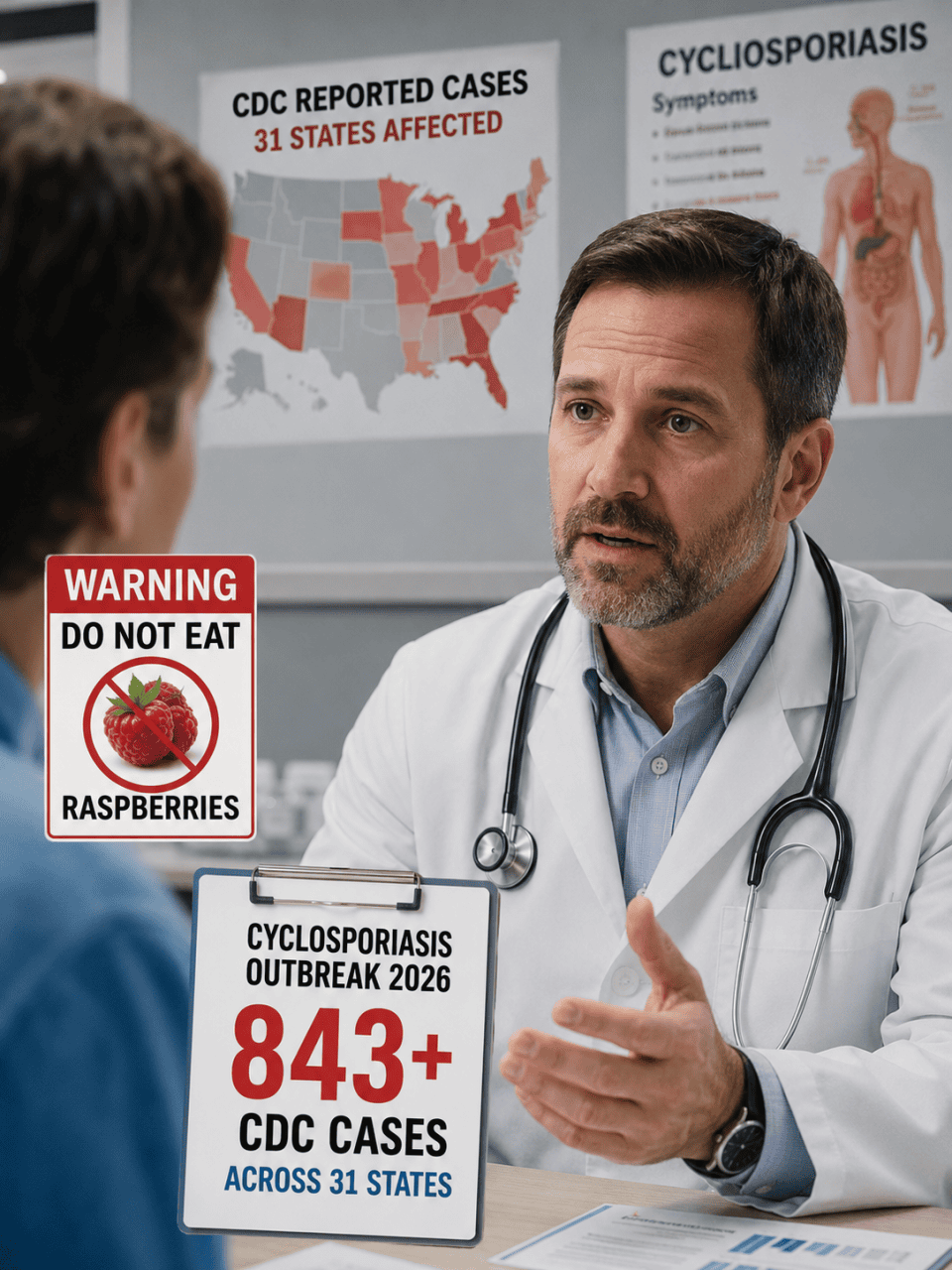
- 843 confirmed cases across 31 US states (CDC, July 9). Michigan alone has 1,562
- No source identified — FDA investigation ongoing. No recall issued
- Raspberries are high-risk — the parasite gets trapped in microscopic hairs on the fruit. Washing does NOT remove it
- Standard stool tests miss it — you must specifically ask for Cyclospora testing
- Key clue: symptoms come and go in waves for weeks (relapsing-remitting pattern)
- Treatable — Bactrim (TMP-SMX) for 7-10 days works
What Is Cyclosporiasis?
Cyclospora cayetanensis is a single-celled parasite that infects the small intestine. Unlike bacteria that cause food poisoning within hours, Cyclospora takes about 7 days after exposure to make you sick.
This matters because: if you ate something 12 hours ago and got sick, it’s not Cyclospora.
The 2026 Outbreak by the Numbers
| Source | Cases | Affected Area | As of |
|---|---|---|---|
| CDC (federal) | 843 | 31 states | July 9 |
| Michigan DHHS | 1,562 | 43 counties | July 10 |
| Estimated total | ~3,000 | 31+ states | July 13 |
The FDA has not yet identified the contaminated food. This means no recall has been issued — you cannot protect yourself simply by avoiding a known product.
6 Symptoms to Watch For
- Watery diarrhea — 6-10 bowel movements per day at peak, often described as explosive
- Severe fatigue — worse than you’d expect from diarrhea alone
- Stomach cramps and bloating
- Loss of appetite and weight loss
- Nausea
- Low-grade fever (under 101°F / 38.5°C) — only in about 1 in 3 cases
The #1 Clue: It Comes and Goes
Most stomach bugs hit hard, then get better and stay better. Cyclospora is different.
It creates a relapsing-remitting pattern: you feel better for a day or two, then symptoms return at full strength. This cycle repeats for weeks.
If your “stomach bug” keeps coming back after seeming to resolve, consider Cyclospora.
Why Raspberries Are a Problem
The Cyclospora oocyst (infectious form) is 8-10 micrometers — roughly the size of a red blood cell.
Raspberries have microscopic papillae (hair-like projections) on their surface. The parasite gets physically trapped in these hairs. Washing cannot remove it. The CDC states that rinsing produce is “not likely to remove” Cyclospora. Cooking kills it. Freezing does not.
Foods linked to past outbreaks:
- Raspberries (multiple outbreaks)
- Cilantro (Mexico-origin)
- Basil
- Snow peas
- Bagged salad mixes
- Mesclun lettuce
What to Say to Your Doctor
This is critical. Standard stool tests check for Salmonella, E. coli, and Shigella. They do NOT test for Cyclospora.
If you have diarrhea lasting more than 3-5 days, especially with the relapsing pattern, say this exact sentence:
“I’m concerned about Cyclospora given the current outbreak. Can you order modified acid-fast staining or PCR specifically for Cyclospora?”
Without this request, you may be told “it’s probably viral” and sent home with a treatable infection.
Treatment
| Situation | Treatment |
|---|---|
| Adults | TMP-SMX DS (Bactrim) twice daily for 7-10 days |
| Children | Weight-based dosing — ask your pediatrician |
| Sulfa allergy | Requires infectious disease specialist — no proven alternative |
| Symptom relief | Imodium helps symptoms but does NOT cure the infection |
Cyclospora Foods to Avoid Right Now
If you live in a state with confirmed cases (Michigan, Ohio, Indiana, Illinois, and 27 others), the safest move is simple: avoid raw produce until the FDA names the source. Here is the practical list, ranked by risk.
1. Raw raspberries — highest risk
Raspberries are the single most common Cyclospora vehicle in past US outbreaks (2013, 2018, 2020, 2022). The parasite hides in microscopic hairs on the berry surface, so washing does not reliably remove it. Freezing does not kill it either. Cooked raspberries (in jams or baked goods) are safe because heat kills Cyclospora.
2. Cilantro
Cilantro has been linked to repeated Cyclospora outbreaks (2013, 2015, 2018). The FDA’s current traceback (July 2026) is actively investigating cilantro, onions, and cucumbers. If you cook cilantro into a dish, it is safe — raw garnish and fresh salsas are the risk.
3. Basil
Basil was linked to a 2019 Cyclospora outbreak and is on the historical high-risk list. Pesto made with fresh basil should be avoided unless the basil is cooked or you can confirm its source.
4. Onions and cucumbers (current investigation)
The FDA traceback as of late July 2026 is focused on cilantro, onions, and cucumbers. Onions and cucumbers are usually eaten raw, so during the active outbreak, cook them or avoid fresh salsa, salads, and raw toppings from restaurants.
5. Bagged lettuce and salad mixes
No current lettuce recall is tied to this outbreak, but bagged mesclun and salad mixes were linked to Cyclospora in 2020 and 2022. Washing reduces but does not eliminate risk — cooking or choosing cooked vegetables is safer right now.
What Foods Are Safe Right Now?
- Anything cooked or roasted — heat kills Cyclospora. This is the one guarantee.
- Frozen produce you cook (frozen peas, corn, spinach in dishes)
- Canned fruits and vegetables
- Whole fruits you peel — bananas, oranges, melons you slice yourself, avocados
- Cooked beans, grains, and animal products
Rule of thumb: if you did not cook it or peel it, and it came from the fresh produce aisle in an outbreak state, avoid it until the FDA names the source.
When to see a doctor: if you have watery diarrhea that lasts more than 3 days, or diarrhea plus dehydration, fever, or blood in the stool, get tested for Cyclospora specifically — standard stool panels often miss it. Antibiotics (Bactrim) are effective.
Does washing, soaking, or freezing make produce safe?
No. The CDC states that washing produce reduces surface contaminants but does not reliably eliminate Cyclospora, because the parasite can be trapped in crevices (raspberries) or survive inside the plant tissue. Vinegar and saltwater soaks are not proven effective. Cooking is the only reliable method.
Cyclospora vs. Stomach Virus: How to Tell the Difference
| Norovirus / Stomach Bug | Cyclosporiasis | |
|---|---|---|
| When it starts | 12-48 hours after exposure | ~7 days after exposure |
| How long it lasts | 1-3 days | Weeks to months if untreated |
| Pattern | Gets bad, then better (once) | Comes and goes in waves |
| Fatigue level | Mild | Severe, disproportionate |
| Stool test needed? | No | Yes — must be specifically ordered |
| Treatment | Rest and fluids | Prescription antibiotic (Bactrim) |
How to Protect Yourself (Until the Source Is Found)
- Cook your produce — heat kills Cyclospora. This is the only guaranteed method
- Avoid raw raspberries, cilantro, and basil during the outbreak (highest historical risk)
- Wash produce under running water — reduces risk but does not eliminate it
- Scrub firm produce (carrots, potatoes) with a brush
- Wash hands after handling fresh produce
Cyclosporiasis Outbreak Map
States with confirmed cases: Michigan (1,562 — largest cluster), Ohio, Indiana, Illinois, New York, North Carolina, plus 25 additional states.
For the most current map, check the CDC Cyclosporiasis page.
Quick Answers
Can I catch it from another person?
Rare. The parasite needs time in the environment before it becomes infectious.
Can I get it again after treatment?
Yes. Reinfection is possible. No long-lasting immunity.
Should I throw away my raspberries?
The CDC hasn’t named a specific food. If you’re in a high-incidence state (Michigan, Ohio, Indiana, Illinois), avoiding raw raspberries and cilantro is a reasonable precaution.
Does hand sanitizer kill it?
No. Alcohol-based sanitizers do not reliably kill Cyclospora. Wash with soap and water.
Sources
- CDC Cyclosporiasis Surveillance
- FDA Active Outbreak Investigations
- FDA Cyclospora Information
- Michigan DHHS
- Medical Daily Produce Safety Guide
Multiple breakout searches this week mention Taco Bell and Taylor Farms in connection with the Cyclospora outbreak. The FDA has not officially named either as a confirmed source as of July 13. However, past Cyclospora outbreaks have been linked to produce from Taylor Farms, and Taco Bell has faced produce-related investigations before. Neither company has issued a recall. If you ate at Taco Bell recently and developed diarrhea 7 days later, mention it to your doctor. The FDA investigation is ongoing. Bottom line: Until the FDA confirms a source, avoid raw raspberries, cilantro, and basil — the highest-risk foods from past outbreaks. Lettuce recall is surging in search this week. Here is what you need to know. There is no confirmed link between current lettuce recalls and the Cyclospora outbreak as of July 13. Lettuce recalls are typically issued for E. coli or Salmonella contamination — different bacteria that cause illness within hours, not days. If you recently bought bagged lettuce and see a recall notice, check the FDA recall list. The current Cyclospora outbreak has not been linked to lettuce by the FDA. However, bagged salad mixes and mesclun lettuce have been linked to Cyclospora outbreaks in past years (2020, 2022). Until the source is identified, washing all bagged lettuce before eating is a reasonable precaution.What About Taco Bell and Taylor Farms?
Is the Lettuce Recall Related to Cyclospora?
July 16 Update: 7,000 Suspected Cases — What Changed
Two weeks ago, this post covered the early Cyclospora outbreak. Here is what has changed since then:
- 1,645 confirmed cases across 34 states (up from a few hundred)
- 5,100 additional cases under investigation — nearly 7,000 total suspected
- Michigan remains the epicenter with 3,309 confirmed cases
- 4-state cluster confirmed: Michigan, Ohio, West Virginia, Kentucky
- 141 hospitalizations (9% of confirmed cases)
- Zero deaths
New Information: FDA Traceback on Cilantro, Onions, Cucumbers
An internal CDC email obtained by CNN reveals the FDA is running traceback on cilantro, white and green onions, and cucumbers for a separate set of cases in Illinois, New York, Pennsylvania, and Texas linked to Mexican-style restaurants and a grocery chain.
Michigan officials say lettuce and salad mixes are the likely source of their outbreak. The CDC says multiple outbreaks from different sources are happening simultaneously.
Colorado: 90 Cases, But Not Linked to the Outbreak
Searches for “cyclosporiasis in colorado” spiked to 100 interest this week. But the data tells a different story:
- 90 cases reported in Colorado between January and June 2026
- None are linked to the multistate outbreak
- The majority are travel-related — patients recently traveled internationally
- Colorado is close to its five-year average of about 167 cases per year
- State epidemiologist Dr. Rachel Herlihy: “There is no reason to believe that there is any increased risk of exposure to cyclospora from eating produce in Colorado”
Key Detail: CDC Tracking Has Been Scaled Back
Frequently Asked Questions
What should I do if I notice these symptoms?
If you notice any of the symptoms discussed in this article, schedule an appointment with your doctor. Early detection and treatment can prevent complications. Do not wait for symptoms to worsen.
How common is this condition?
This condition affects millions of people worldwide. According to the CDC, prevalence has increased significantly in recent years. You are not alone, and effective treatments are available.
Can this be prevented?
While not all cases are preventable, lifestyle changes including regular exercise, a balanced diet, adequate sleep, and stress management can significantly reduce your risk. Talk to your doctor about personalized prevention strategies.
The CDC recently reduced its foodborne illness tracking programs, including cyclosporiasis surveillance. This means official numbers likely undercount actual cases significantly. The CDC acknowledged 5,100 cases “require further analysis before they can be confirmed.”
Sources
- CDC Cyclosporiasis Surveillance (July 14, 2026)
- NBC News: Nearly 7,000 Cases Suspected
- CBS Colorado: 90 Cases, No Outbreak Link
- CNN: Outbreak Expands to More States
Last updated July 16, 2026.
When to See a Doctor
Consult a healthcare provider if you experience:
- Symptoms that persist for more than two weeks
- Symptoms that interfere with daily activities or sleep
- Symptoms that worsen despite home treatment
- Any sudden or severe changes in your health
Bottom Line
Always consult a qualified healthcare provider for personalized advice.
Related Articles
- Darebee Review 2026: Is It Actually Worth Your Time?
- Is There a Stomach Bug Going Around Right Now? Cyclospora Outbreak 2026 Symptoms and What to Know
Sources
Part of our Infectious Diseases Guide — a complete guide to this topic.
