
Affiliate Disclosure: This article contains affiliate links. If you buy through one of them we may earn a commission, at no extra cost to you. We only recommend products we genuinely believe in. As an Amazon Associate I earn from qualifying purchases.
Medical Disclaimer: This content is for informational and educational purposes only and is not medical advice. Always consult a qualified healthcare professional before making health decisions or starting any new treatment.
Last Updated: July 28, 2026 | Medically Reviewed by Grace Oluchi, Medical Graduate
Key Takeaways
- Major Pharmaceuticals recalled 12 lots of levothyroxine sodium tablets on July 13, 2026. The FDA classified it as a Class II recall on July 17.
- The tablets are subpotent — they contain less thyroid hormone than the label states.
- Seven strengths are affected: 25 mcg, 50 mcg, 75 mcg, 88 mcg, 112 mcg, 125 mcg, and 150 mcg.
- Do not stop taking your levothyroxine without talking to your doctor first.
- This is the third levothyroxine recall in 12 months — Pfizer/Levoxyl and Alvogen Thyro-Tabs were recalled in 2025.
- Synthroid (the brand name version) has not been recalled.
- Approximately 20 million Americans take levothyroxine daily for hypothyroidism.
Quick Answer: What You Need to Know Right Now
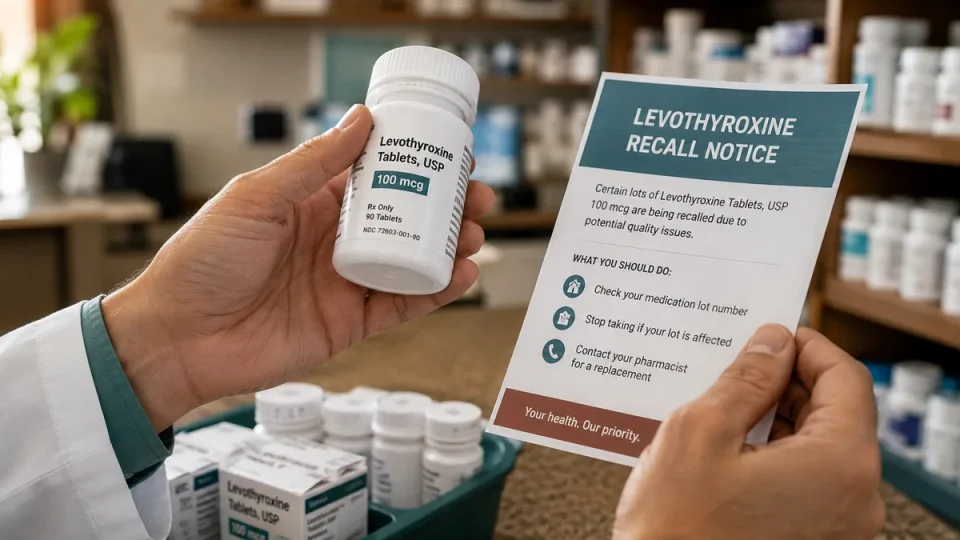
Recalled: Major Pharmaceuticals levothyroxine sodium tablets, 12 lots, 7 strengths (25-150 mcg). Issue: Subpotent (less hormone than labeled). Action: Check your lot number against the FDA list. Do NOT stop medication — contact your doctor for guidance and possible prescription transfer.
Levothyroxine Recall 2026: What Happened & Why It Matters
Levothyroxine is a synthetic form of the thyroid hormone T4. It is the most commonly prescribed medication for hypothyroidism — a condition where the thyroid gland does not produce enough hormone.
In the United States, nearly 5 out of every 100 people aged 12 and older have hypothyroidism. Most of the estimated 30 million Americans with thyroid dysfunction have this condition. Levothyroxine is the backbone of treatment.
The problem: routine stability testing found that certain batches of levothyroxine sodium tablets did not meet the required potency standards. In plain language, the pills may deliver less thyroid hormone than the dose printed on the label.
This is called a subpotent drug — it is not contaminated or dangerous in the traditional sense. But if a patient takes a pill that is supposed to be 75 mcg and it actually contains only 60 mcg, their hypothyroidism can become undertreated.
The July 2026 Recall: Major Pharmaceuticals
On July 13, 2026, Major Pharmaceuticals (based in Dublin, Ohio, with packaging in Indianapolis, Indiana) initiated a voluntary recall of levothyroxine sodium tablets. The FDA classified it as a Class II recall on July 17, 2026.
Some of these products were also distributed by Cardinal Health (Dublin, Ohio).
Shipping of the affected products began on January 22, 2025.
What Class II means: The FDA defines a Class II recall as a situation where “use of or exposure to a violative product may cause temporary or medically reversible adverse health consequences.” In practice: the medication may not work as well as it should, but it’s not toxic.
Complete List of Recalled Lots & Strengths
| Strength | NDC | Lot Number | Expiration |
|---|---|---|---|
| 25 mcg | 0904-6789-61 | 220138 | 02/2027 |
| 50 mcg | 0904-6789-61 | 220139 | 02/2027 |
| 75 mcg | 0904-6789-61 | 220140 | 02/2027 |
| 88 mcg | 0904-6789-61 | 220141 | 02/2027 |
| 112 mcg | 0904-6789-61 | 220142 | 02/2027 |
| 125 mcg | 0904-6789-61 | 220143 | 02/2027 |
| 150 mcg | 0904-6789-61 | 220144 | 02/2027 |
Total: 12 lots across 7 strengths. All manufactured by Major Pharmaceuticals, distributed by Cardinal Health.
How to Check If Your Medication Is Recalled
- Find your bottle — look at the prescription label
- Locate the NDC (National Drug Code) — usually on the side/bottom of the label
- Match the lot number — printed near the expiration date
- Verify strength & expiration — match both against the table above
Can’t find it? Call your pharmacy — they have dispensing records and can check instantly.
What “Subpotent” Means for Your Health
The recalled tablets are subpotent — they contain less levothyroxine than the label states. This is not contamination or toxicity. The risk is undertreatment.
What Happens If You Take Subpotent Levothyroxine?
- Hypothyroid symptoms return: fatigue, weight gain, cold intolerance, constipation, depression, brain fog
- TSH rises: Your pituitary pumps out more TSH trying to stimulate the thyroid
- Long-term risks: untreated hypothyroidism → high cholesterol, heart disease, infertility, myxedema (rare)
Timeframe: Symptoms may appear within 2-6 weeks of taking subpotent medication. TSH typically rises within 4-6 weeks.
What to Do If Your Medication Is Recalled
Step 1: Do NOT Stop Taking Your Medication
Stopping levothyroxine abruptly is dangerous. Even subpotent medication provides some hormone. Stopping entirely can trigger myxedema crisis — a life-threatening condition.
Step 2: Contact Your Prescriber Immediately
- Your doctor may order a TSH test to check current levels
- They may prescribe a different brand (Synthroid, Levoxyl, Unithroid, Tirosint)
- They may adjust your dose based on current TSH
Step 3: Contact Your Pharmacy
- Ask for a brand substitution (Synthroid, Levoxyl, Unithroid, Tirosint)
- Ask if they have unaffected lots in stock
- Request a “brand medically necessary” note from your doctor if insurance requires it
Step 4: Schedule a TSH Test
- When: 4-6 weeks after switching medications
- Target: TSH 0.5-2.5 mIU/L (or per your doctor’s target)
- Frequency: Every 6-8 weeks until stable, then every 6-12 months
Levothyroxine Recall History: 2025-2026 Timeline
| Date | Manufacturer/Brand | Issue | FDA Class |
|---|---|---|---|
| July 2026 | Major Pharmaceuticals | Subpotent tablets (12 lots) | Class II |
| 2025 | Pfizer / Levoxyl | Subpotent | Class II |
| 2025 | Alvogen / Thyro-Tabs | Subpotent | Class II |
Pattern: Three recalls in 12 months, all for subpotency. This suggests a manufacturing/stability issue across the generic levothyroxine supply chain.
Brand vs Generic: What You Need to Know
Synthroid (Brand) — NOT Recalled
- Manufactured by AbbVie
- Tighter manufacturing controls
- Higher cost, but consistent potency
- Often preferred by endocrinologists
Generic Levothyroxine — Multiple Recalls
- Manufactured by various companies (Major Pharma, Alvogen, Pfizer/Levoxyl, etc.)
- FDA allows 90-110% potency range — generics can vary within this range
- Multiple recalls in 12 months suggest stability challenges
- Cost savings: $4-15/month vs $40-80/month for Synthroid
Should You Switch to Synthroid?
- Yes, consider if: You’ve been affected by a recall, have difficulty stabilizing TSH, or are pregnant/planning pregnancy
- Maybe not if: Your TSH is stable on current generic, cost is a major concern
- Ask your doctor: “Would you recommend switching to brand-name Synthroid given the recent recalls?”
Levothyroxine Alternatives & Substitutions
| Brand/Generic | Status | Form | Notes |
|---|---|---|---|
| Synthroid | ✅ Not recalled | Tablet | Brand, most consistent |
| Levoxyl | ⚠️ Recalled 2025 | Tablet | Pfizer recall 2025 |
| Unithroid | ✅ Not recalled | Tablet | Generic alternative |
| Tirosint | ✅ Not recalled | Gel cap | Liquid-filled, better absorption |
| Tirosint-SOL | ✅ Not recalled | Liquid | For swallowing difficulties |
| Thyro-Tabs | ⚠️ Recalled 2025 | Tablet | Alvogen recall 2025 |
FAQ: Levothyroxine Recall 2026
1. How do I know if my specific pills are affected?
Check the lot number and NDC on your prescription bottle against the table above. If unsure, call your pharmacy — they can check dispensing records.
2. Should I stop taking my medication?
NO. Even subpotent medication provides some hormone. Stopping entirely can trigger myxedema crisis — a life-threatening emergency. Contact your doctor first.
3. Will my pharmacy automatically replace it?
Most pharmacies will proactively contact affected patients and offer a substitution. But don’t wait — call them proactively.
4. Will insurance cover a brand switch to Synthroid?
Many plans require “brand medically necessary” documentation from your doctor. Ask your doctor’s office to submit this if they recommend switching.
5. How long until I know if my dose needs adjusting?
Schedule a TSH test 4-6 weeks after switching medications. TSH typically stabilizes in 4-6 weeks.
6. Is Synthroid also being recalled?
No. Synthroid (AbbVie) has not been recalled. It’s manufactured under tighter controls.
7. What if I’m pregnant or planning pregnancy?
Thyroid hormone is critical for fetal brain development. Discuss switching to Synthroid with your OB/GYN and endocrinologist immediately if affected by recall.
8. Can I use a different strength pill to compensate?
No. Do not self-adjust by taking extra pills. Work with your doctor for proper dose adjustment.
What to Do If You’ve Been Taking Recalled Lots
- Don’t panic — subpotency means undertreatment, not poisoning
- Contact your doctor this week for TSH test & brand switch
- Call your pharmacy for immediate brand substitution
- Get TSH tested in 4-6 weeks after switch
- Monitor symptoms: fatigue, weight gain, cold intolerance, constipation, depression
- Keep records of lot numbers, dates, symptoms for your records
Official Resources & References
- FDA Recall Notice: FDA Recalls Page
- FDA Enforcement Report: Weekly enforcement reports with recall details
- FDA Drug Safety: Drug Safety Communications
- Thyroid Association: American Thyroid Association
- Endocrine Society: Clinical Guidelines
Bottom Line
Check your lot number. If affected, don’t stop — call your doctor and pharmacy today. Switch to an unaffected brand (Synthroid, Unithroid, Tirosint) and get TSH tested in 4-6 weeks. This is the third levothyroxine recall in 12 months — consider discussing a permanent switch to Synthroid with your doctor for long-term stability.
Share this article with anyone taking levothyroxine — it could protect their thyroid health.
Sources
- FDA Enforcement Report, July 17, 2026 — Class II Recall: Major Pharmaceuticals Levothyroxine Sodium
- FDA Drug Safety Communication: Levothyroxine Sodium Tablets Recall
- American Thyroid Association — Hypothyroidism Treatment Guidelines 2024
- American Association of Clinical Endocrinologists — Thyroid Medication Position Statement
- FDA Drug Safety Communication Archive 2025-2026
