
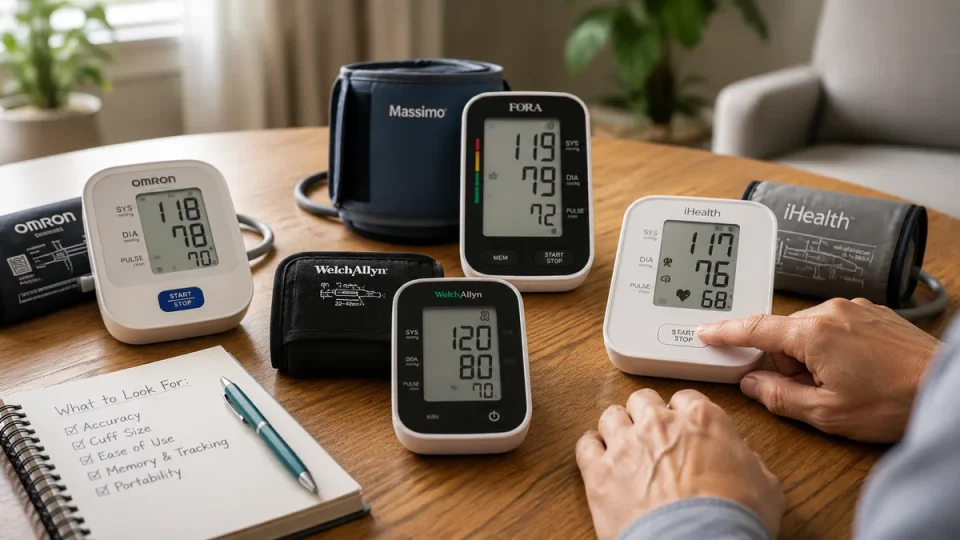
Hypertension affects nearly half of all American adults — that is about 116 million people. The scary part? About 1 in 3 have it and do not know it.
Home blood pressure monitoring is one of the simplest things you can do to protect your heart. A 2022 study in Hypertension found that people who monitored their blood pressure at home were 40% more likely to reach their target blood pressure compared to those who only checked at the doctor’s office.
As a doctor in training, I have seen patients miss early warning signs of hypertension because they only checked their blood pressure once every few months. A good home monitor gives you the data you need to catch problems early.
I reviewed the top blood pressure monitors on the market for 2025, focusing on accuracy, comfort, ease of use, and value. Here are my top picks.
Quick Comparison: Best Blood Pressure Monitors at a Glance
| Monitor | Type | Price Range | Best For | Accuracy |
|---|---|---|---|---|
| Omron Platinum | Upper arm | $75 – $90 | Overall best | A+ |
| Omron Silver | Upper arm | $40 – $55 | Budget pick | A |
| Withings BPM Connect | Upper arm | $80 – $100 | Smart features | A |
| Beurer BM67 | Upper arm | $45 – $60 | Large cuffs | A- |
| iHealth Feel | Wireless upper arm | $55 – $70 | Cordless convenience | A- |
| Omron Evolv | Wireless upper arm | $70 – $85 | Portability | A |
Note: Affiliate links will be added once my affiliate accounts are approved. For now, check Amazon for the latest prices.
Best Overall: Omron Platinum BP Monitor
The Omron Platinum is the gold standard for home blood pressure monitoring. It uses TruRead technology, which takes three consecutive readings one minute apart and averages them — the same method cardiologists use in their offices.
Here is why I recommend it as the best blood pressure monitor for most people:
- Clinically validated accuracy — meets the Association for the Advancement of Medical Instrumentation (AAMI) standards
- Dual-display screen — shows current reading and previous reading side by side
- Stores 200 readings for two users (100 each)
- Bluetooth connectivity — syncs with the Omron Connect app
- Irregular heartbeat detection — alerts you if an arrhythmia is detected
The cuff fits arm circumferences from 9 to 17 inches, which covers most adults. The display is large and backlit, making it easy to read even in low light.
Best Budget: Omron Silver Upper Arm Monitor
If you want a reliable monitor without spending much, the Omron Silver delivers 90% of the Platinum’s features at half the price.
- One-touch operation — simple enough for anyone to use
- Stores 80 readings for one user
- Omron Connect app compatible
- Clinically validated — same accuracy standards as the Platinum
The main difference from the Platinum: no TruRead technology (you get single readings instead of averaged readings) and less memory. For most people, this is perfectly fine.
Best Smart Monitor: Withings BPM Connect
The Withings BPM Connect is the most tech-forward blood pressure monitor on this list. It looks like something Apple would design — sleek, minimalist, and connected.
- Wi-Fi and Bluetooth — syncs automatically without opening an app
- Integrates with Apple Health, Google Fit, and Samsung Health
- Unlimited storage in the Withings app
- Multi-user support — automatically detects who is using it
- Color-coded readings — green (normal), orange (elevated), red (high)
The color-coded system is particularly helpful. It gives you instant visual feedback on whether your reading is in a healthy range, without needing to memorize blood pressure categories.
Best for Larger Arms: Beurer BM67
Finding a blood pressure monitor with a large cuff is a common problem. Most monitors come with cuffs that fit 8 to 13-inch arms. If your arm circumference is larger, you need the Beurer BM67.
- Cuff fits 8.5 to 17.7 inches — one of the widest ranges available
- Stores 60 readings
- Risk indicator — classifies readings according to WHO guidelines
- Large backlit display
The Beurer BM67 is especially useful for patients with larger body frames who struggle with standard cuffs. A cuff that is too small will give falsely high readings, which can lead to unnecessary medication changes.
Best Cordless: iHealth Feel Wireless Monitor
The iHealth Feel eliminates the cord entirely. The entire unit is wireless — just the cuff and the device, nothing plugged into a wall.
- Fully wireless design — no tubes, no cords
- Stores 99 readings
- Bluetooth syncs with the iHealth MyVitals app
- LED indicator — shows reading quality with color
The wireless design makes this the best blood pressure monitor for travel. It fits easily in a bag and works anywhere without needing an outlet.
Best for Portability: Omron Evolv
The Omron Evolv is the smallest clinically validated blood pressure monitor available. The entire device is built into the cuff — no separate base unit.
- All-in-one design — cuff contains the monitor
- Stores 200 readings
- Bluetooth connectivity with Omron Connect
- Validated by the British Hypertension Society
If you need to check your blood pressure at work, while traveling, or on the go, the Evolv is the most portable option that still delivers clinical-grade accuracy.
How to Measure Blood Pressure Correctly
Even the best monitor will give inaccurate results if you do not use it properly. Here is the correct technique based on American Heart Association guidelines:
- Sit quietly for 5 minutes before measuring
- Place the cuff on your bare upper arm, about 1 inch above the elbow
- Support your arm on a table so the cuff is at heart level
- Do not talk during the reading
- Take 2-3 readings, 1 minute apart, and average them
- Measure at the same time daily — morning and evening are best
A 2023 study in the Journal of the American Heart Association found that improper measurement technique accounts for up to 30% of inaccurate readings. The most common mistake is talking during the measurement.
When to See a Doctor About Blood Pressure
Home monitoring is a tool, not a replacement for medical care. See a doctor if:
- Your readings are consistently above 130/80 mmHg
- Your readings are consistently below 90/60 mmHg
- You get different readings on your left arm vs. right arm (a difference of more than 10 mmHg is significant)
- You have symptoms like headaches, chest pain, shortness of breath, or vision changes
- Your monitor detects an irregular heartbeat
Understanding Your Blood Pressure Readings
| Category | Systolic (Top Number) | Diastolic (Bottom Number) |
|---|---|---|
| Normal | Less than 120 | Less than 80 |
| Elevated | 120 – 129 | Less than 80 |
| High Blood Pressure Stage 1 | 130 – 139 | 80 – 89 |
| High Blood Pressure Stage 2 | 140 or higher | 90 or higher |
| Hypertensive Crisis | Higher than 180 | Higher than 120 |
Source: American Heart Association blood pressure categories
Blood Pressure Monitor Buying Guide
Cuff Size
This is the most important factor. A monitor with the wrong cuff size will give inaccurate readings. Measure your arm circumference at the midpoint between your shoulder and elbow. Most adults need a standard cuff (8 to 13 inches), but you may need a large cuff (13 to 17 inches) or extra-large cuff (17 to 21 inches).
Clinical Validation
Look for monitors that are clinically validated by independent organizations. The AAMI (Association for the Advancement of Medical Instrumentation), ESH (European Society of Hypertension), and BHS (British Hypertension Society) are the gold standards. All monitors on this list meet these standards.
Memory and Connectivity
If you track your blood pressure over time (which you should), look for a monitor with:
- At least 60 readings of memory
- Bluetooth or Wi-Fi to sync with your phone
- Multi-user support if more than one person will use it
Display
A large, backlit display makes readings easier to read, especially for older adults or those with vision problems. Color-coded displays (like the Withings BPM Connect) provide instant feedback on whether your reading is healthy.
Power Source
Most monitors run on 4 AA batteries, which last about 6 months with regular use. Some models (like the Withings BPM Connect) have rechargeable batteries. AC adapters are available for some models but are usually sold separately.
Frequently Asked Questions
How often should I check my blood pressure?
For most adults, check once in the morning and once in the evening for the first week after getting a new monitor. After that, once or twice a week is usually enough unless your doctor recommends more frequent monitoring.
What time of day is best for measuring blood pressure?
Morning measurements should be taken before breakfast and medication. Evening measurements should be taken before dinner. Consistency is more important than the specific time.
Should I check blood pressure on both arms?
Yes, but only when you first start monitoring. Check both arms and use the arm with the higher reading going forward. A consistent difference of more than 10 mmHg between arms may indicate a problem — discuss it with your doctor.
How long do blood pressure monitors last?
Most monitors last 3 to 5 years with regular use. They should be recalibrated every 1 to 2 years to maintain accuracy. Some manufacturers offer calibration services.
Can smart watches measure blood pressure?
Currently, no smartwatch is approved by the FDA for clinical-grade blood pressure measurement. The Samsung Galaxy Watch has blood pressure monitoring in some countries, but it requires calibration with a traditional cuff. Wrist monitors in general are less accurate than upper arm monitors.
Is wrist or upper arm blood pressure monitor better?
Upper arm monitors are more accurate than wrist monitors. The American Heart Association recommends upper arm monitors because the artery in the upper arm is at heart level, while the wrist artery is smaller and more sensitive to position changes.
Bottom Line
For most people, the Omron Platinum is the best blood pressure monitor. It combines clinical-grade accuracy with smart features and is easy to use. If you are on a budget, the Omron Silver delivers reliable results at a lower price.
Whatever monitor you choose, remember: the device is only as good as the technique. Follow the measurement guidelines above, track your readings over time, and share the data with your doctor.
Hypertension is called the “silent killer” because it often has no symptoms. A $50 to $100 investment in a home blood pressure monitor could save your life.
Related Articles
Sources
- American Heart Association — Understanding Blood Pressure Readings
- Hypertension Journal — Home Blood Pressure Monitoring Study (2022)
- Journal of the American Heart Association — Measurement Technique Study (2023)
- Association for the Advancement of Medical Instrumentation — Blood Pressure Monitor Standards
